
Chasing Complexity in so-called Jazz
And why odd meters, advanced poly-rhythms and nested tuplets won't save you

A couple of years ago I was talking with a friend in New York who is a prominent so-called jazz/creative musician in the field of what I jokingly call “complexity jazz.” I forget exactly the context—I guess we were talking about improvised music or something—but at some point he quipped, “well, everything is on the grid, if you make it fine enough” or something like that. (For the uninitiated: the grid refers to the metrical grid made up of subdivisions that musicians use as the framework to generate rhythms.) Actually, what my friend said was mathematically wrong, and I told him so—he didn’t know that I had been working on exactly that problem for a couple of years already.
In traditional western music notation (which uses the grid)— even New Complexity compositions by Brian Ferneyhough, etc.—we rely on ratios (rational numbers/fractions), and only ratios to generate rhythms. Irrational numbers do exist though, and actually they are quite common in nature: √2 and π are two such numbers. In any case, even for many rhythms that could theoretically be expressed on the grid, human playability is also a factor (I don’t know anyone who can play the 23 subdivision of 71, for instance). So, needless to say, there are many rhythms out there that render the grid concept impractical. Before you complexity jazz or new complexity nerds get your nickers in a twist though, this requires a bit more explanation. Brian Ferneyhough himself uses something he calls “irrational time signatures.” Christian Lillinger mentioned them on a recent instagram post, in fact. What’s that about? Actually, it’s a misnomer. So-called “irrational time signatures” have nothing to do with irrational numbers. So-called irrational time signatures are simply non dyadic time signatures—time signatures whose denominators are not powers of two (2, 4, 8, 16, etc). They are still, however, ratios, and therefore, by definition, rational. So-called irrational time signatures are not just misnomers, but in fact are quite the opposite of what they imply.
Irrational numbers, however, have also been used by composers (like Conlon Nancarrow and myself) to generate rhythms or tempi changes.
Who cares? Why am I telling this totally nerdy story? Well, the more I thought about my discussion with my friend, especially after my article on innovation being frozen, the more I thought our conversation was pretty illustrative of the stylist v. restructuralist question (to use Anthony Braxton’s terms): Stylists, while nevertheless doing interesting work within a particular sphere, are subject to path-dependence, and fail to question, or simply choose not to question with their work, the fundamental assumptions and limitations of their musical tools and practices. In the case of my friend, he overestimated the power of the grid, both from a strictly mathematical and from a practical point of view, treating it with almost religious reverence. He did that, despite being an amazing musician and highly intelligent person with a unique voice on his instrument and in his compositions.
In 2020, I had a revelation about using non-fractional (or, truly irrational) time signatures, programmed a sequencer using the rhythms and used them in some places on my album Carny Cant. I also still use the irrational rhythms sequencer in my ever-expanding saxophone/laptop project Irrational Rhythms and Shifting Poles. (I only recently found out that Nancarrow used √2 for a tempo change in one of his pieces, but til now I still haven’t found anyone who uses irrational rhythms at the level of the bar. I’m sure someone else is doing it, so if you know someone, please tell me in the comments!)
In the end, I find the practical application of irrational rhythms relatively limited, at least for my purposes. However, the metaphorical impact they had on me was profound. It got me thinking more about ways of discovering or simply researching deep rhythmic possibilities outside the grid. Javier Areal Velez uses chance to find points within a fixed time-frame where the drum machine is triggered, and that “bar” is then repeated. So a repeatable ostinato is created, and perhaps can even be internalized by a performer, although the trigger points are not gridded at all. Therefore they resist the typical conceptualization that requires the counting of equal subdivisions. You can hear some of that music here.
The use of randomness or the use of irrational numbers to generate rhythms is a reproducible mathematical approach. But deep rhythmic study and deep rhythmic discovery doesn’t have to involve that, either. Personally, practicing and trying to internalize uncountable rhythms (irrational rhythms are by definition uncountable) was interesting because I knew, scientifically, I was playing something that could not be internalized or conceptualized in the normal way we conceptualize rhythms. It also was different from understanding a rhythm as simply being a pushed or pulled countable rhythm. The only way to play them is by really feeling it in your body and remembering the sound itself. In this way you have to get into the sound and deep-time without relying on counting. However, one can also achieve something similar by practicing how Billie Holiday subtly plays behind or ahead of the beat, how blues musicians push and pull time, how baroque interpreters stretch certain notes, or how folk musicians from around the world create complex uncountable, or partially uncountable rhythmic patterns. One would also be hard-pressed to fit some Ornette Coleman Prime Time recordings all on the grid, and even if you could, I daresay you would be missing the point of the music. I also went through a phase where I was practicing rhythm in speech. Above all, one can create ones own unique rhythmic fingerprint by simply playing and not being afraid to play outside the grid. There are also fresh approaches to rhythm that are actually on the grid but don’t involve complex ratios or polyrhythms. There are many possibilities in phasing rhythms, additive rhythms or hocketing rhythms, for instance—all of which I don’t hear so often in jazz/creative music writing. There is, however, quite an abundance of people playing and writing complex ratios and odd meters.
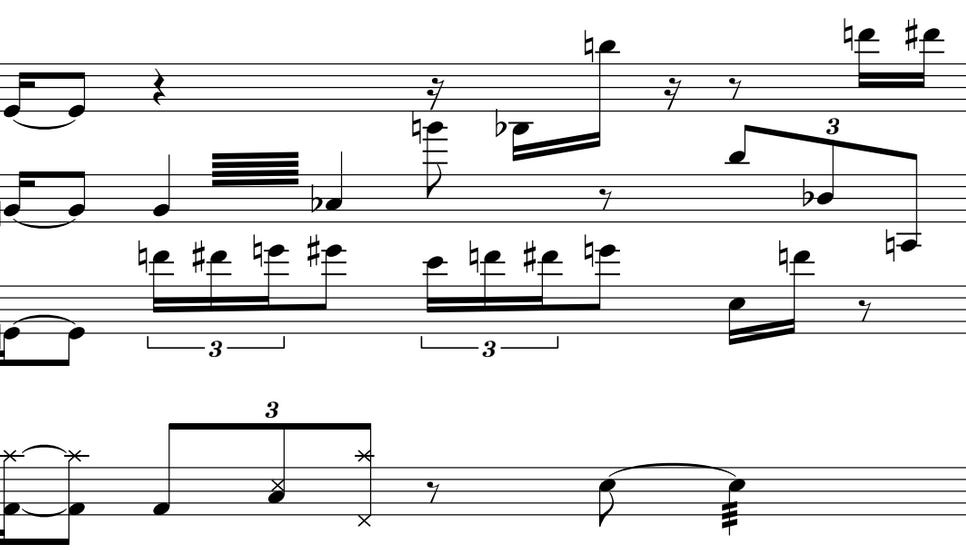
As a brief aside, I do want to give some much deserved respect, and also take some time for self-reflection. The image at the top of this article is an excerpt of a score of my own. Much of the music I have made in the past involved a lot of challenging rhythms, time signatures changing each bar, and even, in the piece “Droll Noon” on my album One Eye with a Microscope Attached, so-called irrational time signatures (i.e. non-dyadic time signatures). There are people who are much more capable of playing and improvising over complex rhythms than I am, and I have a ton of respect for them. These are people who have dedicated their lives to playing their instruments, and have done something that really couldn’t be dreamed of 35 years ago. These super-musicians can not only play written music involving such insane rhythmic complexity, but can also improvise really creatively and with feeling over these extremely challenging forms. While doing that, many of them have assimilated other aesthetics I am partial to, like noise, spectralism, microtonality, good melodic and contrapuntal development, improvisation, etc.
In other words, rather than wasting my time roasting the low hanging fruit (like the people who write a little diatonic melody—or maybe don’t even bother—and then scronk some “free jazz” between; or the group of cool kids playing bad improvised music in endless ad-hoc groups at badly curated festivals across Europe), I want to take on a subject worthy of my consideration. I also am thinking of something a friend of mine told me recently which is that the thing you love the most might also be the thing you hate the most. So, I hope that my colleagues, as well as those who love their music, understand that my observations come from a place of respect. I hope my discussion creates discourse and dialogue, not frustration and alienation.
In conclusion, the point I am trying to make here is not to place an objective judgment on rhythms on or off the grid, but to simply observe that the modern so-called jazz field is very crowded with people pursuing the study of advanced-ratio based rhythms and advanced meter rhythms on a very high level, and such study and practice often forms the backbone of their music. This fascination doesn’t necessarily come from inherent unavailability of other roads towards innovation, but merely a trend going back to the 90s. Personally, I think it’s easier to find myself and hear my own voice in a lonely field rather than a crowded one.
once again seems like you’re missing the forest for the trees. The “pursuit”, or use of these structures as an add-on to people’s broader musical knowledge doesn’t inherently limit what they can do. when it comes to playing with other people, whether in an improvised setting or dealing with scores/direction and everything in between, having a well rounded understanding of different rhythms and how they can bounce off each other goes a long way to increase the possible outcomes (factoring in self awareness and conviction with ideas). Or more succinctly, One can study these ratios and apply them, however abstractly, to a much larger picture they are painting.
Of course, many are guilty of thinking that merely writing something complex and performing the ink is enough for the music to be something. Obviously it isn’t. There are many other parameters of music that contribute to the resulting sound, and they all need to be addressed. Otherwise the outcome might be terrible, and we can certainly agree about short diatonic melodies and going free, or bad free jazz.
However, The “respect” given to your peers in this post doesn’t do much to clarify the purpose of your writing. What exactly is the thorn in your side, that makes this a “subject worth tackling”? It mainly reads like an attempt to add another blanket demographic of artists to the list of people who are inferior to you artistically, which is totally fine! Just should be presented that way instead of this facade of improving the music scene lol
LOVED those late 90's Dave Holland records when I was in college. I wanted to be funky in 13 so hard.
AI stuff has gotten surprisingly good at reconstituting isolated stems from recordings. It's neat because you can start to decompose "feels" with a lot more flexibility than you could before. Can be a nice information source.