
Starmaker Machine
Introducing the first CP Unit Album in Six Years

I have been quiet on here for a while. I was happy to contribute to the discussion in our little corner of the cultural scene, but realistically I can’t do it all the time. In the last couple of months, rather than writing substack articles and making podcasts, I have (among other things) been putting the final touches on an album I have been working on for about nine months.
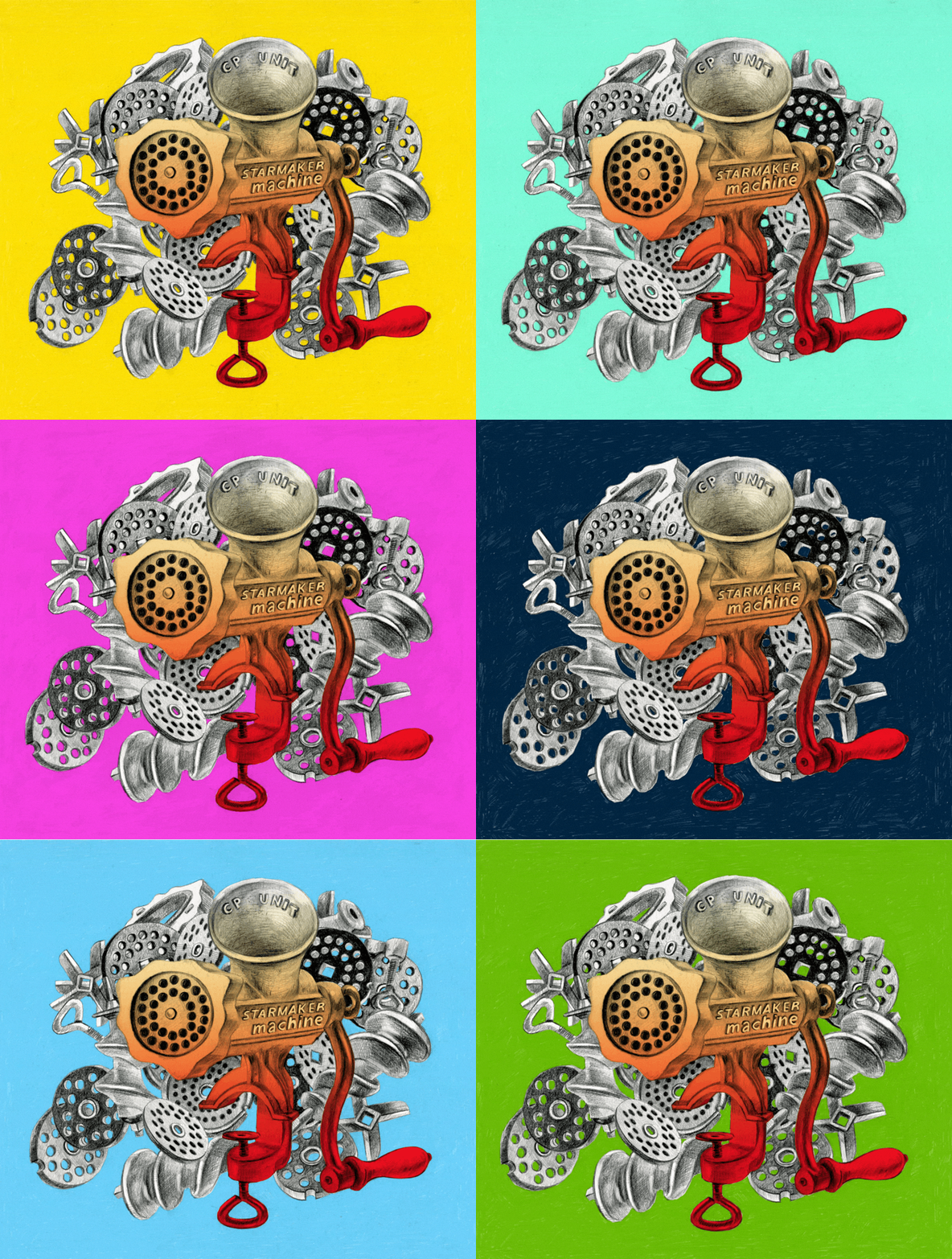
[Album art by Katharina Huber]
Starmaker Machine is the first CP Unit album in six years, featuring myself on alto saxophone, Marta Warelis on synthesizer, Dan Peter Sundland on electric bass, and Luca Marini on drums. It is a two-CD set, with more than 130 minutes of music. The first CD was recorded in the studio, and the second was recorded live. It’s my longest album to date. It’s maybe my best album to date.
In the six years since the last album, a lot has changed. For one, I moved from New York to Berlin, which meant I formed a band with all new members. Making another CP Unit album (the 5th), felt like a daunting task at first. I wanted to maintain some level of sonic continuity with the previous albums: the energy, density, complexity, high tempos, catharsis, FUN, and, more or less, instrumentation (It’s the first album with synth instead of guitar, but functionally the synth plays a similar role.)
However, my compositional proclivities have drastically shifted. In particular, I feel that my approach to open-form composition—something I have been interested in since I was 20—has finally matured. Open form compositions allow the performers to collaboratively generate form during the course of a performance according to a particular set of rules, using concrete or abstract musical instructions or modules. Some examples include Christian Wolff’s For 1, 2, or 3 People, John Zorn’s Cobra, George Lewis’ Artificial Life and P Multitudinis, and, to a certain degree Karlheinz Stockhausen’s Plus-Minus.
With this piece, I developed a system of inter-related decision-making akin to a game of chess. You can think of each of the modules of musical material as representing one square on a conceptual chess board. The performers have memorized all of the material: both their own and that of the other members of the band. By recognizing which musical module the other musicians are playing, they can place them in this conceptual space. After doing that, each performer can make decisions about which material they will play next, thereby collectively forming a series of preconceived aural constellations within that conceptual space. The sequence in which those aural constellations occur, and which musician forms which node of each of those constellations, are, however, not predetermined and must be negotiated in real time without any cue-based communication. That’s the fun of the piece, and why it results in (I think) something interesting musically. Unlike many open form pieces, there are no cues at all—neither visual nor aural—yet there is concrete communication that goes on. In other words, this piece allows performers to communicate meaningfully to each other without telling them what to do. The material itself represents something that does not determine what the other performers should do, but rather determines what the meaning of each possible decision would be. This is also just like chess: the same move can have drastically different meanings depending on where the other pieces are on the board (the same move could result in a check mate for you, or for your opponent, depending…). Unlike chess though, there are no losers in this game: only winners :-) You, the listener, may not know the system exactly, but can certainly perceive that a sort of dance is occurring between the musicians.
We had a lot of fun making this album. I think it is quite nice to listen to. I would love to hear your thoughts on it. Right now only two tracks are streamable (40 minutes). The whole thing will be available when it’s released on July 3. Give it a go by clicking here.